
Cerca
Galileo Chini



Artisti
Virtual Tours & 360 Videos
Discover our 360 immersive presentations



Description
BIOGRAPHY
1873-1895
Galileo Andrea Maria Chini was born in Florence on December 2, 1873 to Elio Chini – a tailor and flugelhorn player – and Aristea Bastiani. In 1885, when he was just twelve years old, his parents died and he was taken in by his paternal uncle Dario, a successful decorator and restorer of frescoes. Dario enrolled him in decoration courses at the Santa Croce School of Art in Florence where, studying alongside the three Coppedè brothers and Ugo Giusti, he acquired a repertoire of cherubs, candelabras and tangles of vegetation. Galileo assisted his uncle in decorating the Torlonia Castle in Serra Brunamonti in Umbria, where he did neo-medieval paintings and charcoal drawings. In 1889 he began working in the atelier of the Friulian painter Amedeo Buontempo, helped his uncle with restoration work in Florence’s Santa Trinita and, under the guidance of architect Corinto Corinti, assisted with the documentation and surveying of the Mercato Vecchio (Old Market), as testified by numerous watercolored and tempera drawings of architectural parts, pottery finds and especially fourteenth- and fifteenth-century frescoes. His first major decoration effort dates to 1894: Augusto Burchi, painter, fresco artist and restorer influenced by French style, hired him to decorate the ceiling of the reception hall of Palazzo Budini-Gattai in Florence, where he created a mock tapestry and a frieze, collaborating with Giulio Bargellini. In 1895 in Volterra, he did cleaning and restoration work in the Conti Guidi Chapel in San Francesco, and frescoed local families’ coats of arms in the Greater Council Hall of Palazzo dei Priori. It was there that he met Elvira Pescetti, who would become his wife. He enrolled at the Free School of the Nude at the Academy of Fine Arts of Florence, which he attended until 1897.
1896-1903
Galileo, embittered by the sale of the Ginori ceramics firm in Doccia to the Milanese industrialist Augusto Richard, joined with Giovanni Vannuzzi, Vittorio Giunti and Giovanni Montelatici to found the Manifattura Arte della Ceramica, which shared many of the ideals of the English “Arts and Crafts” movement regarding the revival of artistic handicraft. The logo they chose proclaimed the firm’s vocation from the outset: a pomegranate, D’Annunzian and pre-Raphaelite symbol of fecundity, along with clasped hands signifying brotherhood. Pre-Raphaelite influences were prominent in Chini’s early ceramics, and in eight illustrations he published in the magazine “Fiammetta”. In 1897 he participated in the selection process for the International Exposition Festival of Art and Flowers in Florence; although not accepted, he did show his work in the exhibition for non-accepted artists. His firm Arte della Ceramica, which in the meantime had brought in as collaborators Chino, Augusto and Guido Chini and the son of the sculptor Emilio Zocchi, won the gold medal at the 1898 Decorative Arts Expositions in Turin and London. Galileo married Elvira, and they had a daughter, Isotta, the following year, and a son, Eros, in 1901. In 1900, Arte della Ceramica triumphed at the Paris International Exposition, earning the Grand Prix for its experimentation with metallic lusters and the early products of what would become a fruitful relationship with architecture, far ahead of its time. The modernist style of the firm’s ceramics, with stylized and calligraphic modules, also won top prizes at the International Expositions of Brussels, Ghent and Petersburg, all held in 1901. In these first years of the 20th Century, the firm also produced the decorations for the interior of Florence’s Palazzo Davanzati. Galileo participated in the Venice Biennial for the first time in 1901 with Quiete, a work that marked a shift in his painting towards divisionism. In 1902, Arte della Ceramica again triumphed at the International Decorative Arts Expositions in Turin, presenting splendid pieces in gres as well as a dining room, exhibition room and bathroom completely tiled in polychromatic lustred majolica. Requests for its tiles for architectural uses, which had already gained notoriety at the 1900 Paris Exposition, were so numerous that in 1901 the factory had to enlarge its kilns and move from a small space in Florence to a large warehouse in Fontebuoni. In 1903 Galileo supervised the set-up and decoration of the Tuscany Hall at the Venice Biennial; he placed a frieze in lustred majolica along the upper part of the walls, and showed his works La Sfinge and Un Tramonto.
1904-1905
In 1904, along with Ludovico Tommasi, Chini showed five highly symbolist works at the Secessione della Promotrice Fiorentina at Palazzo Corsini. The exhibition’s impact won him an appointment to decorate the Cassa di Risparmio di Pistoia e Pescia bank, where he used an innovative type of painting, abandoning traditional neutral tones and classical division into square or rectangular panels to move towards the new floral, secessionist style. He painted the ceiling of the ballroom at the Grand Hotel La Pace in Montecatini – one of his first masterpieces -, the theater-café of the Palace Theatre (no longer in existence) and the façade of the pavilion in front of the old Cinema Verdi, on which Domenico Trentacoste depicted Galileo himself in gres, listening to the Muses. The gres panels were created for Arte della Ceramica’s pavilion at the 1902 Turin Exposition. At the 1904 St. Louis Exposition, Arte della Ceramica won the Grand Prix and Galileo received the silver medal as the firm’s artistic director, a role he was forced to give up that same year due to differences with his partners, who insisted on his constant presence in the factory, to the detriment of his career in painting and decoration. In 1905 Galileo worked with Ludovico Tommasi, Adolfo De Carolis, Salvino Tofanari and Giacomo Lolli in setting up the first Tuscan Art Exposition, and also participated in the Venice Biennial, showing Il Trionfo (allegoria) and La Campagna, as well as handling the decoration of the Tuscan Hall. He also frescoed the Cassa di Risparmio di Arezzo building, an historic palazzo associated with the Albergotti and Bacci families.
1906-1908
In 1906 he and his cousin Chino Chini founded the Manifattura Fornaci San Lorenzo in Borgo San Lorenzo; as a logo, they chose a grate - the emblem of the martyrdom of the homonymous saint - crowned by a Florentine fleur-de-lis and the word “Mugello”. The new manufacturing firm, dedicated to both pottery and glass, expanded its production in gres, even decorating entire buildings. Galileo decorated the “Young Etruria” hall at the International Exposition in Milano, which was destroyed in a fire but reconstructed within just a few weeks, exactly replicating the style of the original pavilion. With Leto Chini he created the first of a long series of decorations for chapels in the Antella Cemetery. In 1907, working with Plinio Nomellini and the sculptor Edoardo De Albertis, he realized the L’arte del Sogno hall at the Venice Biennial, where he showed Icaro, Il Giogo and Il Battista (affresco). The room, which included a gres floor with leafy motifs and peacocks, a decorative band running along the upper part of the walls with a procession of cherubs and garlands, and friezes and above-door decorations by De Albertis, established him as one of the most devoted exponents of European symbolism, and earned him a commission from the King of Siam in Bangkok to decorate his Throne Palace. He began to design the stage sets for Shakespeare’s A Midsummer Night’s Dream at the Teatro Argentina in Rome. We have a letter dated December 31st from Plinio Nomellini regarding the purchase of a plot of land in a pine wood where a “Vacation house” would be built in 1914 according to plans by Chini and the architect Ugo Giusti in the town of Fossa dell’Abate, now Lido di Camaiore and the site of the Chini Archive. In 1908 Chini organized and participated in the I Biennial of Art of Faenza, which led to the birth of the International Museum of Ceramics. In December he received an appointment to teach the Free Superior Course in Decoration at the Royal Academy of Fine Arts in Rome, a position he held until 1911; 1908 also saw the staging of Sem Benelli’s La maschera di Bruto at Milan’s Teatro Lirico di Milano, for which Galileo designed 15th-century-style sets, with costumes by Caramba.
1909- 1911
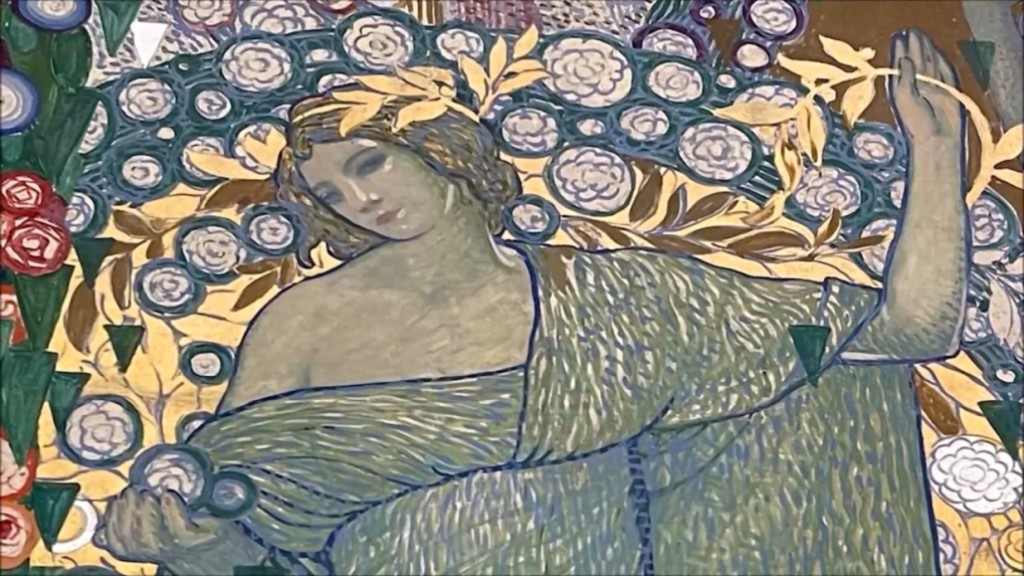
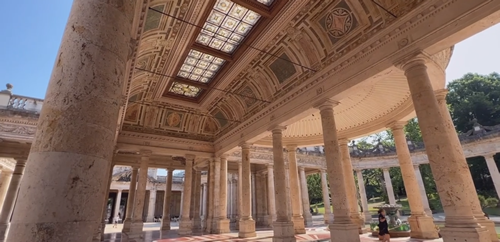
In January and February 1909, Antonio Fradeletto asked Chini to decorate the cupola of the central hall of the Palazzo dei Giardini at the Venice Biennial with frescoes of Allegorie dell’Arte e della Civiltà; the critical success of this work consecrated Chini among the artistic intelligentsia of his day. He created the sets, costumes and poster for Sem Benelli’s La cena delle beffe, presented at Rome’s Teatro Argentina. Chini hired Giusti to design his house at Via del Ghirlandaio, 52 in Florence, for which he decorated the façade himself in 1914, and expanded the space by constructing a studio. He also participated in the Salon d’Automne in Paris, showing an Autoritratto and Il condottiero, along with ceramics from his Fornaci. In 1910 he received the Grand Prix for his decoration of the Italian Pavilion at the International Exposition in Brussels. He realized the decoration for the Stabilimento Terme Tamerici in Montecatini contemporaneously with expansion work under the guidance of Giulio Bernardini, with frescoes, stained glass, ceramics, floors and majolica panels by Chini’s firm. He designed the poster and illustrations for Sem Benelli’s book L’amore dei tre re, which came to be considered Galileo’s “jewel of illustration”. In 1911 he created friezes for the Tuscany Pavilion, designed and executed in collaboration with Ugo Giusti, and the Festival Pavilion for the Ethnographic Exhibition at the International Exposition of Rome, for which he also did the poster. At the end of June, he set sail from Genoa heading to Bangkok, at the invitation of the King of Siam, Rama V, to fresco the Ananta Samakhom Throne Hall; he was then thirty-seven years old, and was one of the most important Italian artists at that time.
1912-1919
In Bangkok, along with the decorators Carlo Rigoli and Giovanni Sguanci, the stucco artist Giuseppe Innocenti and the gilder Giovanni Barsi, Galileo decorated the Ananta Samakhom Throne Hall. He brought back a number of objects from his trip, which he donated to the Museum of Anthropology and Ethnology of Florence. In 1912 he returned to Italy briefly to sort out matters at the Fornaci (to which he had hoped to entrust the realization of stained glass for the Royal Palace in Bangkok), and in 1913 produced the painting La festa dell’ultimo giorno dell’anno cinese a Bangkok, considered the masterpiece of his Siamese period. He returned to Florence definitively between late August and early September of that year. In 1914 he participated in the II Secessione Romana, setting up an exhibition room and showing Danzatrice Monn, and created the cycle of eighteen panels, La Primavera che perennemente si rinnova, for the Venice Biennial space shared with Yugoslavian sculptor Ivan Meštrovič, a clear reference to theosophical and pantheistic symbolism akin to that of the Ver Sacrum. In his own personal room in that exhibition, he also showed a large selection of Siamese works. In 1915 he was appointed to substitute for De Carolis as an instructor at the Academy of Fine Arts of Florence, teaching ornamental design. In Florence, he frescoed the Palazzo dell’Economia, which is today the Chamber of Commerce building. In 1917, with Nomellini and Filippo Cifariello, he published the manifesto Rinnovandoci rinnoviamo, proposing the abolition of Academies and the establishment of artistic-industrial schools blending aspects of architecture, decoration, manufacturing, painting and sculpture. In 1918 he frescoed the City Hall of Montecatini, under the direction of engineer Brizzi. He also designed the stage sets for Gianni Schicchi, part of Puccini’s Trittico, performed at the Metropolitan in New York.
1920-1924
In 1920 he decorated what had been the Meštrovič room at the Venice Biennial with horizontal panels depicting Allegorie dell’arma, dell’esercito e dell’eroismo italiano (La glorificazione dell’Artigliere e dell’Ardito lanciafiamme; del Nocchiero; del Fante; del Lanciere) and showed Il Calvario, Il voto ai dimenticati della terra and Il voto ai dimenticati del mare, as well as two Venetian mosaics of Saints Paul and Jude he had designed. Between 1919 and 1921 he did the decorations for Villa Scalini at Carbonate, on Lake Como, with secessionist-style essential geometries. At the I Roman Biennial he showed the paintings Il mio cortile a Bangkok, Studio, Danzatrice Laos, La danzatrice di Sumatra, La mia veranda, Studio and La perla. In 1921 he began preparing the decorations for the Terme Berzieri, which was being planned by the architect Ugo Giusti, and was inaugurated in 1923, a testament to the peak moment of a creative inspiration fueled by European and Oriental elements, as well as the triumph of Art Déco. Also in 1921 he designed stained glass and ceramic decorations illustrating Marco Polo’s journey in China for the Municipal Hall of the Italian Concession of Tianjin. In 1922 Galileo was nominated “Accademico di Merito Corrispondente” of the Royal Academy of Arts of Brera and showed Episodio at the Venice Biennial. In 1923 he presented the Spada d’onore di S. E. il Generale Conte Guglielmo Pecori-Giraldi, executed by Guido Calori, at the II Rome Biennial. In 1924 he had a solo exhibition room at the Venice Biennial where he showed, along with ceramics, vases, amphorae and plates, the paintings Fecondazione and Nostalgia di Bangkok, and, collaborating with Chino, created a ceramic shrine with Redentore. Invited along with Ugo Giusti and Alfredo Belluomini to head up the regulatory planning Commission for the city of Viareggio, between 1922 and 1923 he decorated numerous buildings with ceramics of his firm’s manufacture (the Gran Caffè Margherita, based on plans by the architect Alfredo Belluomini, the Grand Hotel Excelsior, again collaborating with Belluomini, the Principe di Piemonte hotel and many others). In 1924 he did sketches for the musical version of Sem Benilli’s La cena delle beffe with songs by Umberto Giordano, and began working on sets for Puccini’s Turandot, of which there are four known versions. The Fornaci San Lorenzo won the gold medal and the diploma of honor at the National Ceramics Exhibition in Pesaro.
1925-1930
In 1925 Chini decorated the Grand Hotel des Thèrmes in Salsomaggiore, in conjunction with restoration and expansion work led by Giusti in the hotel’s Moorish salon, red tavern and Hall of the Caryatids, and then turned his attention to the Central and Tabarin Florida cinemas in Sanremo. He participated in the International Decorative Arts Exposition in Paris, on the Esplanade des Invalides, decorating the Italia Pavilion, planned by architect Armando Brasini, with a ceramic frieze with metallic lusters and two panels. Despite the great success he had achieved, Galileo decided to relinquish artistic direction of the Fornaci; he was replaced by Chino’s son Tito, and then by his brother Augusto. In 1926 he designed the decoration of the cupola and interiors for the motor vessel Augustus and the steamship Ausonia for Ducrot (which whom he had previously collaborated on the décor for the transatlantic ship Roma). He designed the cover for Ricordi’s edition of Turandot, and the stage sets for the third and fourth acts of Benelli’s Il vezzo di perle. Around the same time, he did the decoration for two hydroelectric power stations, in Marlengo (Merano) and Mori (Rovereto), both commissioned by the S.E.A.A. Società Elettrica Alto Adige, an arm of the Montecatini group, of which Guido Donegani was at the helm from 1918 to 1935. In 1927 he was appointed to teach Pictorial Decoration to third-year students at the Royal School of Architecture in Florence. In 1928 he completed tempera decorations for the ceilings, walls, cellars and stairways of the new corporate headquarters of the Industria Montecatini in Milan. In 1929 he had a solo show at the Bottega d’Arte in Livorno, and began decorating Palazzo Vincenti on Corso Italia in Pisa, which was then the seat of the Provincial Council of Economics and Labor. He frescoed the atrium and the cupola-topped first-floor vestibule and designed the wrought-iron balcony for the façade of the Provincial Hall in Livorno, later demolished during the second world war. At the 1930 Venice Biennial he showed La Cena, La modella in riposo, Il cavolo, Scia di Monsone and Natura morta-Orata, and that same year created the costumes for Sem Benelli’s Fiorenza. The large decorative cycles of the 1920s marked the end of his most intensive period in terms of decorative work; after that decade, he tended to withdraw frequently to his house in Lido di Camaiore to focus entirely on painting.
1931-1938
April 1931 marked the inauguration of Chini’s first solo show in Paris, at the Bernheim-Jeune gallery. In May he had an exhibition in Florence at the Galleria d’Arte G. Cavalensi e G. Botti, and another in Paris, at the Palais de la Mediterranée. In 1932 an exhibition at Galleria Pesaro in Milan earned him a flattering review from Carrà. He had other shows, in Livorno at the Bottega d’Arte and at the Vitelli gallery in Genoa, together with the sculptor Sirio Tofanari, at the Casa d’Arte in La Spezia and again at the Galleria d’Arte G. Cavalensi e G. Botti in Florence. He drew up three design projects (never carried out) for the competition for the decoration of the royal hall of the Florence railway station. In 1933 he showed Case in Val di Mugnone and Lavanderia del Mugnone at the first exhibition of the National Fascist Syndicate of Fine Arts in Florence, along with Carrà, Carena, Doni, de Chirico, Savinio, Martini, Capogrossi and Cavalli. In 1934 he again had an exhibition at the Galleria G. Cavalensi e G. Botti in Florence, and another at Galleria Genova in Genoa. He took eleven paintings of Tuscan landscapes to the Venice Biennial. In 1935 he had an exhibition at the Galleria Il Cimento in Naples with Zambeletti and Tofanari, and another with Nomellini at the Hotel Croce di Malta in Montecatini Terme. During the mid-1930s, Chini decorated the cafè-restaurant Doney in Florence, the Grand Hotel in Ardenza and the Church of the Sacro Cuore in Camaiore (the latter demolished in the 1950s). In 1936 he had a solo show at the Apollo gallery in Rome and, at the Venice Biennial, presented the paintings I garofani rossi, Ora stanca, La fornace sull’Arno, Primavera and, a non-competing entry, La pensierosa. He also created stage sets for Rossini’s Cenerentola at La Scala in Milan, and made plans for a “Teatro Studio” in the pine wood of Viareggio, which were never carried forth. In 1937 he was nominated as a member of the Royal Academy of Arts and Design of Florence, in the painting category.
1938-1945
In 1938 Chini received several honors: he was named Commander of the Order of the Crown of Italy and of the Order of the White Elephant, as well as Knight of the Order of San Maurizio a Lazzaro. He held an exhibition at the Galleria d’Arte Firenze in Florence, and participated in a group show at Galleria Pesaro in Milan, marking the thirty-fifth year of his career. That same year, he was accused of contempt of civil authority and defamation (charges of which he was later cleared) for having sent a letter of protest to the mayor of Florence against the decoration of the Loggia of the Signoria in Florence for Hitler’s visit. In 1939 he participated in the III Quadrennial of Rome with the work Estate, and created a large panel for the New York ferry terminal, commissioned by the Società Navale Italia. In 1940 he had solo exhibitions at the Fine Arts Society of Florence, Galleria Rotta in Genoa and the Gian Ferrari gallery in Milan, and completed the decoration of the Passeri Chapel in the Scandicci cemetery (no longer extant). In 1942 he decorated the meeting hall of the Casa del Contadino in Bologna and, together with Orsi, Pistelli and Arrighini, organized the first Exhibition of Art and History in Lido di Camaiore, where he had a room exclusively for his work. He also participated in the Tuscan Artists Exposition in Düsseldorf. In 1943 he had solo shows at the Albergo Universo in Lucca, the Galleria d’Arte Trieste in Trieste, the Galleria Permanente Alessandro Gazzo in Bergamo, the Vittoria gallery in Brescia and the Bottega dei Vàgeri in Viareggio. Regrettably, the Fornaci San Lorenzo were bombed in December of 1943 during allied air attacks on the Borgo San Lorenzo railway station. During the evacuation, he and his family moved to Striglianella between Prato and Pistoia, where he painted several works he would later show in a solo exhibition at Galleria Il Cenacolo in Florence in 1944. In 1945, at the behest of CONI, Galileo submitted a grand project to the Municipality of Viareggio to increase tourism in the area, which included plans for sports and cultural centers, shops and hotels. In October, he officially donated to the City of Florence thirteen paintings of various zones of the city that had been destroyed by German mine explosions.
1946-1956
Galileo’s daughter Isotta died prematurely in 1946, and he frescoed her burial chapel in the Antella Cemetery. During the last decade of his life, he slowly lost the hopefulness and vitality of his youth, and came to focus on dark, nocturnal themes in his art. In 1947 he showed at the Exhibition of Nineteenth-century and Contemporary Tuscan Art organized by the Tuscan Press Association at Palazzo Strozzi in Florence. In 1949 he wrote Ricordi del Siam, published in early 1951. Galileo’s production changed and progressively diminished during this period, as he was afflicted with an eye disorder that slowly led to total blindness. In 1951 he showed at the International Exposition of Sacred Art in Rome, and in 1952 the Gallery of the Academy of Fine Arts of Florence dedicated a retrospective to him; that same year, he participated in the first National Art Exhibition in Trieste, and his work Il triste cavaliere won the City of Genoa Prize. His last painting, Follia macabra, dates to 1954, the year in which he participated in the Exhibition of Contemporary Art at Palazzo delle Esposizioni in Rome, organized by the Italian Commission for the Appeal for Children (UNAC, which would then become UNICEF). In 1955 he had a solo exhibition at the City Hall of Pietrasanta, and officially donated most of the Siamese and Oriental objects he had brought back from Bangkok to the Florentine University Ethnology Museum (the donation had originally been made in 1950, but an appropriate place for the collection was not found until five years later). In 1956 he participated in the Mostra Internazionale di Arte Contemporanea Pro Infanzia in Bogotà, Colombia, and in August of that year the City Hall of Pietrasanta organized a retrospective of his work. He passed away in his Via via del Ghirlandaio studio in Florence on August 23rd.
Attachments
Related content
You may also like


