
Cerca
Montecatini and its Mirò


Description
Did you know that the city of Montecatini has a Mirò?
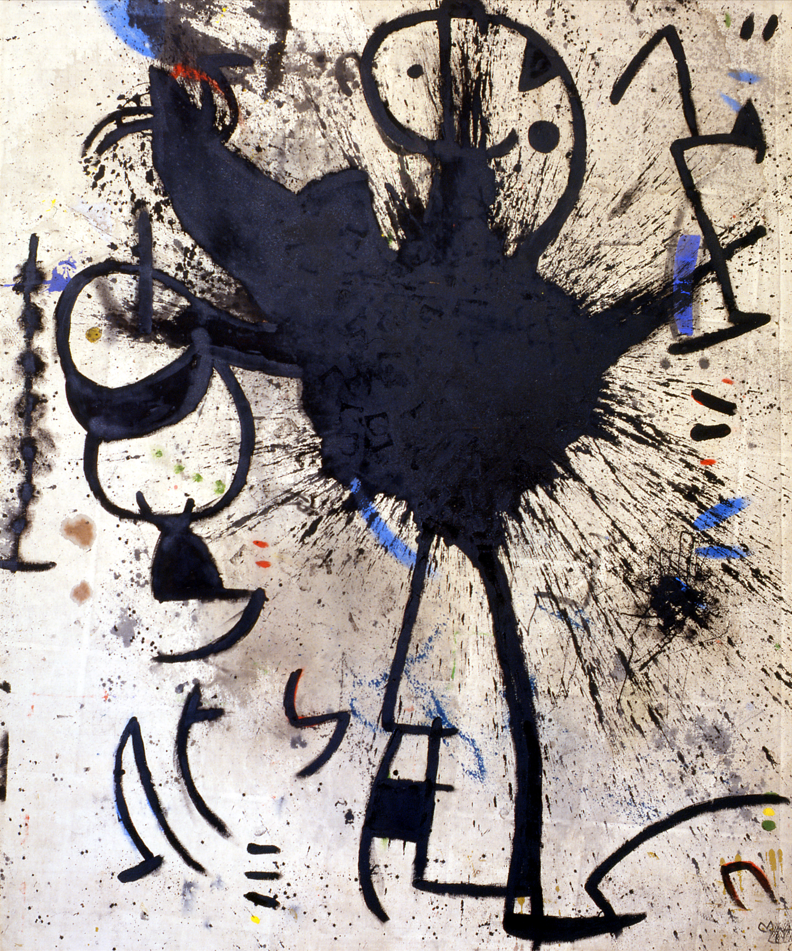
It is Dona Voltada d’un Vol d’Ocells, in Italian Woman wrapped in a bird’s flight, one of the largest works created by the Catalan artist.
The enormous canvas – 3 meters and 15 centimeters high and 2 meters and 60 wide – was painted by the Master specifically to be donated to the spa town.
It was 1980.
The spring of that year was spectacular for Montecatini: an event called Maggio Mirò brought to the city many artists from all over the world who created works inspired by the figure and works of the great Catalan master in order to pay homage to him.
The creator of the event was the well-known Cuban intellectual Carlos Franqui who lived in the spa town at the time.
Thanks to his personal friendship with Mirò since the time of the Cuban revolution and, later, during his exile, he had involved him in the initiative, also guaranteeing his personal presence.
In reality, Mirò never arrived in the city: shortly before his departure, an accident prevented him from his planned trip to Montecatini.
At the time, the Artist was 87 years old and would leave us only three years later.
In the painting, Mirò unleashes all his desperation and anger for this sad unforeseen event that appears as a premonition.
From that immense stain of black paint thrown onto the canvas - distorting the original design of the bird, which he has identified several times, in his personal alphabet, as death - a sense of anguish emerges, the darkest, that which arises from the awareness of the approaching end.
From the prints of the heels, imprinted with anger on the color and still clearly visible, the anger due to the impotence to escape physical decay and death bursts forth.
And the Woman, quintessence of human strength, source of life, important and constant protagonist of his production, where is she?
“For me, what I call ‘woman’ is not the creature woman, it is a universe”, words of the Master.
The representation of this universe that is the female figure, changes over the years, passing from more easily identifiable images – and inspired by primitive icons – to signs of the most diverse forms.
In many paintings in which Mirò announces, through the title of the work, the presence of the woman, that woman seems absent, sometimes it is difficult to find her. Or, if you do find her, it is not a given that in other works she is represented in the same way.
In the painting of the Mo.C.A. she is “portrayed” in the few sinuous lines of primary colors on which predominate, together with the large stain of black paint, important signs of the same color mostly angular.
Almost to signify, in that moment of prostration of one’s existence, the prevalence of the sense of death, identified in the bird, over that of life, identified with the Woman.
There are those who say, and perhaps rightly, that in the Woman of Mirò at the Mo.C.A. there is each of us. Because for everyone the day will come in which the years to come will be counted on the fingers of one hand and the feeling of eternity typical of youth will be replaced by the miseries of old age. And that day, as for Mirò, it will be difficult to escape those emotions of desperation and anger that, together with fear, have such power to obscure the wonder of life.
Curiosity
On the canvas you can still see the imprints of the floor tiles of the studio in Palma de Mallorca where Mirò painted it. After all, it is the Artist himself who tells us about his working technique: “I put my paintings on the floor. When I’m on the floor, I can walk on them. On the floor I work lying on my stomach. Oh yes, I get all dirty with paint, face, hair, I find splashes everywhere”
Joan Miró, 1974
Joan Miró, 1974
On the left you can see two brown stains. They don’t have the typical appearance of the signs of Mirò’s alphabet… In fact, they aren’t. They are stains of coffee that the artist dropped on the canvas while he was working on it.
To his friend Franqui who had gone to visit him in Palma de Mallorca and who had suggested that he remove them since the work was a gift, Mirò replied no. “In Italy, when two friends meet or a boy approaches a girl, the most natural thing is to ask to have a coffee together …” The small traces of the drink themselves become a symbol of the bond between the work and Italy, the country that will welcome it.
To his friend Franqui who had gone to visit him in Palma de Mallorca and who had suggested that he remove them since the work was a gift, Mirò replied no. “In Italy, when two friends meet or a boy approaches a girl, the most natural thing is to ask to have a coffee together …” The small traces of the drink themselves become a symbol of the bond between the work and Italy, the country that will welcome it.
Unable to come to Montecatini, the artist entrusted the large painting to Franqui so that he could bring it as a gift to the city as a tangible testimony of his participation in the event. At the time, 1980, the European Union did not yet exist. To arrive in Italy, the painting would have been subject to the payment of customs duties, money, a lot, that the Municipality did not have. And so it was that the canvas arrived in Montecatini wrapped on the shoulders of the Cuban as if it were a Persian carpet!
On the back of the work, the title and dedication to the city, signed Mirò.
The official delivery of the painting took place in Rome on September 16, 1980.
Finally ... we like to remember the great Catalan with the words of his grandson, Joan Punyet Miró:
“Joan Miró suffered greatly in his life, especially as a young man. He knew hunger, he suffered exile during the Spanish Civil War, he faced difficult trials. And after the exile, the war and the abuses of Francoism, he never forgot those in need, the refugees, the dissidents and the weak.”